Thursday, January 14, 2016

How cells in a fruit fly embryo know what to do

Our favorite morphogen system is the dorsal-ventral (DV) axis specification in the Drosophila melanogaster (fruit fly) embryo.  In this system, a protein called "Dorsal" has a high concentration (in the nucleus) on the ventral side of the embryo and a low concentration on the dorsal side.  (By the way, if you're wondering why it seems the name is backwards -- why is Dorsal absent on the dorsal side, but present on the ventral side? -- you might want to read our post here.)  It also directs the cells along the DV axis to express different genes, in a concentration dependent fashion.  So Dorsal acts as a morphogen.

If you read our post introducing the idea of a morphogen, you know that the typical way a morphogen concentration gradient forms is by a small set of cells producing the protein, then diffusion causes the concentration of that protein to spread out.  This is not the case with Dorsal.  It is present everywhere, but cannot act because it's bound to an inhibitor protein called Cactus.  (Yes, seriously, it's called Cactus.  Again, you might want to read about why fruit fly gene names are so weird.)

But, on the ventral side of the embryo, a signal from the receptor Toll causes Cactus to be degraded, which releases Dorsal, allowing it to go into the nucleus and direct gene expression (see the above figure).  This "Dorsal nuclear concentration gradient" (see figure below) is one of the earliest signals to direct the cells in the fly embryo to differentiate into different types, specifying (from ventral to dorsal) muscle, neuron, skin, and an extraembryoinc tissue called the amnioserosa.  So the Dorsal gradient is very important, and is one of the more well-studied morphogen systems.
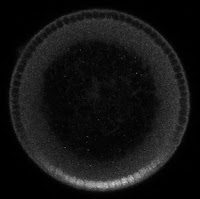
The Dorsal nuclear concentration gradient: This is a cross section of a 2.5 hr old fruit fly embryo that has been treated so that Dorsal protein fluoresces.  Dorsal protein is concentrated in the embryo's nuclei on the ventral side (bottom), and depleted on the dorsal side (top).

Wednesday, December 9, 2015

Of Course Biology Exhibits Engineering Principles

Just as every human-designed system must conform to standard engineering principles — discovered by trial and error — in order to work efficiently, so must biological systems at all levels be replete with engineering principles in order to maintain proper fitness.

Thursday, November 12, 2015

Why are fruit fly gene names so weird?

My lab studies the fruit fly (Drosophila melanogaster), which is one of the most well-studied animal systems.  Historically, fruit flies have been studied because the genetics is very easy.  Early on, the way to study genetics was to cause the flies to become mutated (altering their DNA randomly), and then see what happened.  Well, some pretty funky things happened.

Sometimes, the resulting flies looked all bristly -- researchers named that mutation "hedgehog".  Sometimes, they looked like a tube -- researchers called that mutation, well, "tube".  And so, names like "armadillo", "wingless", "cactus", "pipe", and "dachshund" were born.

Later, scientists found that these mutations mapped to genes within the flies' DNA.  Naturally, these genes were named after the mutation that the researchers originally found. 

It turns out that  one of the first mutations geneticists worked with was a spontaneous mutation that they named "white".  Well, guess what this mutation did?  It turned the turned the flies' eyes from red to white.  So when the genes were later named for the mutation involved in their discovery, the gene responsible for turning the flies' eyes red was called "white".  Brilliant!

So this is why many genes in the fly genome are named backwards.

Wednesday, October 28, 2015

How do cells know what to do in an embryo?

One of the biggest questions that has been on the minds of biologists is how are tissues patterned?  In other words, how do cells make decisions in a developing embryo?  How does a cell know to become skin rather than muscle?  Or stomach lining rather than bone marrow?

The general answer (although the details are still being worked out) is called the "morophogen gradient model".

A morphogen, or a protein or other small molecule, serves as a signal to tell cells what to do.  Imagine a bunch of cells in a sheet that will eventually become part of a tissue.  Each of these cells will become something different from their neighbors, but initially, they are all the same.

At one end of this sheet of cells, a set of cells (blue in the figure) produces a secreted protein (the morphogen) that diffuses through the extracellular space next to the cells. The cells capture the morphogen.  As the morphogen gets further away from the cells that produced it, the concentration of the morphogen decreases (brown curve in the figure). 


One might think of the cells that produce the morphogen as a cell phone tower, and the further away one gets, the less signal one would perceive.  And the cells then respond depending on how much morphogen they perceive (white, red, and gray in the figure).  So two cells next to each other will perceive different amounts of signal (morphogen), and they will know to do different things.  One might become a neuron, while the other a skin cell.

In this way, a single signal, in the form of a secreted protein called a morphogen, can pattern an entire tissue.

Monday, October 26, 2015

If we can expect engineering principles in biology...

If biology is rife with engineering principles, then why not use that as a predictive tool? 

Thursday, October 8, 2015

Engineering principles are everywhere!

One of the observations that scientists have made about biology is that is it rife with engineering principles.  But of course we should expect such a thing.  Any man-made structure that we build would surely fail unless it is in accord with good engineering principles.  Why should anything less be expected of living systems?