Our favorite morphogen system is the dorsal-ventral (DV) axis specification in the Drosophila melanogaster (fruit fly) embryo. In this system, a protein called "Dorsal" has a high concentration (in the nucleus) on the ventral side of the embryo and a low concentration on the dorsal side. (By the way, if you're wondering why it seems the name is backwards -- why is Dorsal absent on the dorsal side, but present on the ventral side? -- you might want to read our post here.) It also directs the cells along the DV axis to express different genes, in a concentration dependent fashion. So Dorsal acts as a morphogen.
If you read our post introducing the idea of a morphogen, you know that the typical way a morphogen concentration gradient forms is by a small set of cells producing the protein, then diffusion causes the concentration of that protein to spread out. This is not the case with Dorsal. It is present everywhere, but cannot act because it's bound to an inhibitor protein called Cactus. (Yes, seriously, it's called Cactus. Again, you might want to read about why fruit fly gene names are so weird.)
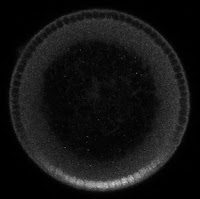
But, on the ventral side of the embryo, a signal from the receptor Toll causes Cactus to be degraded, which releases Dorsal, allowing it to go into the nucleus and direct gene expression (see the above figure). This "Dorsal nuclear concentration gradient" (see figure below) is one of the earliest signals to direct the cells in the fly embryo to differentiate into different types, specifying (from ventral to dorsal) muscle, neuron, skin, and an extraembryoinc tissue called the amnioserosa. So the Dorsal gradient is very important, and is one of the more well-studied morphogen systems.
Showing posts with label Drosophila. Show all posts
Thursday, January 14, 2016
Thursday, November 12, 2015
Why are fruit fly gene names so weird?
My lab studies the fruit fly (Drosophila melanogaster), which is one of the most well-studied animal systems. Historically, fruit flies have been studied because the genetics is very easy. Early on, the way to study genetics was to cause the flies to become mutated (altering their DNA randomly), and then see what happened. Well, some pretty funky things happened.
Sometimes, the resulting flies looked all bristly -- researchers named that mutation "hedgehog". Sometimes, they looked like a tube -- researchers called that mutation, well, "tube". And so, names like "armadillo", "wingless", "cactus", "pipe", and "dachshund" were born.
Later, scientists found that these mutations mapped to genes within the flies' DNA. Naturally, these genes were named after the mutation that the researchers originally found.
It turns out that one of the first mutations geneticists worked with was a spontaneous mutation that they named "white". Well, guess what this mutation did? It turned the turned the flies' eyes from red to white. So when the genes were later named for the mutation involved in their discovery, the gene responsible for turning the flies' eyes red was called "white". Brilliant!
So this is why many genes in the fly genome are named backwards.
Subscribe to:
Posts (Atom)
