Our favorite morphogen system is the dorsal-ventral (DV) axis specification in the Drosophila melanogaster (fruit fly) embryo. In this system, a protein called "Dorsal" has a high concentration (in the nucleus) on the ventral side of the embryo and a low concentration on the dorsal side. (By the way, if you're wondering why it seems the name is backwards -- why is Dorsal absent on the dorsal side, but present on the ventral side? -- you might want to read our post here.) It also directs the cells along the DV axis to express different genes, in a concentration dependent fashion. So Dorsal acts as a morphogen.
If you read our post introducing the idea of a morphogen, you know that the typical way a morphogen concentration gradient forms is by a small set of cells producing the protein, then diffusion causes the concentration of that protein to spread out. This is not the case with Dorsal. It is present everywhere, but cannot act because it's bound to an inhibitor protein called Cactus. (Yes, seriously, it's called Cactus. Again, you might want to read about why fruit fly gene names are so weird.)
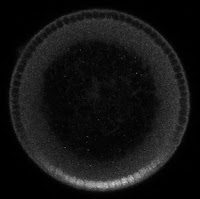
But, on the ventral side of the embryo, a signal from the receptor Toll causes Cactus to be degraded, which releases Dorsal, allowing it to go into the nucleus and direct gene expression (see the above figure). This "Dorsal nuclear concentration gradient" (see figure below) is one of the earliest signals to direct the cells in the fly embryo to differentiate into different types, specifying (from ventral to dorsal) muscle, neuron, skin, and an extraembryoinc tissue called the amnioserosa. So the Dorsal gradient is very important, and is one of the more well-studied morphogen systems.
Showing posts with label morphogen gradient. Show all posts
Thursday, January 14, 2016
Wednesday, October 28, 2015
How do cells know what to do in an embryo?
One of the biggest questions that has been on the minds of biologists is how are tissues patterned? In other words, how do cells make decisions in a developing embryo? How does a cell know to become skin rather than muscle? Or stomach lining rather than bone marrow?
The general answer (although the details are still being worked out) is called the "morophogen gradient model".
A morphogen, or a protein or other small molecule, serves as a signal to tell cells what to do. Imagine a bunch of cells in a sheet that will eventually become part of a tissue. Each of these cells will become something different from their neighbors, but initially, they are all the same.
At one end of this sheet of cells, a set of cells (blue in the figure) produces a secreted protein (the morphogen) that diffuses through the extracellular space next to the cells. The cells capture the morphogen. As the morphogen gets further away from the cells that produced it, the concentration of the morphogen decreases (brown curve in the figure).
One might think of the cells that produce the morphogen as a cell phone tower, and the further away one gets, the less signal one would perceive. And the cells then respond depending on how much morphogen they perceive (white, red, and gray in the figure). So two cells next to each other will perceive different amounts of signal (morphogen), and they will know to do different things. One might become a neuron, while the other a skin cell.
In this way, a single signal, in the form of a secreted protein called a morphogen, can pattern an entire tissue.
Subscribe to:
Posts (Atom)

